A Professional Guide for Importers, Distributors, Retailers and Global Brands
Automatic soap dispensers have become an increasingly popular choice for modern bathrooms, kitchens, hotels, offices, and commercial facilities. By combining touchless dispensing technology with convenient soap management, these devices offer a practical solution for improving everyday handwashing experiences.
For importers, wholesalers, retailers, and private-label brands, choosing the right automatic soap dispenser involves more than comparing prices and appearance. Product compatibility, sensor performance, waterproof protection, battery life, dispensing accuracy, manufacturing quality, and customization capabilities all influence long-term product performance and customer satisfaction.
In this guide, we explain how automatic soap dispensers work, explore the main product types, highlight important purchasing considerations, and discuss what buyers should look for when selecting an OEM/ODM manufacturing partner.
1. What Is an Automatic Soap Dispenser?
An automatic soap dispenser is a touchless device that uses a sensor to detect a user's hand and automatically release a controlled amount of soap or cleaning liquid.
Unlike traditional manual pumps, users do not need to press a button or touch the dispenser directly. Most modern models use infrared sensing technology to detect hand movement and activate an electronic pump.
Depending on the design, an automatic soap dispenser can dispense liquid soap, foaming soap, hand sanitizer, or other compatible cleaning products.
How Does a Touchless Soap Dispenser Work?
A typical automatic soap dispenser operates through five main components:
- Sensor: Detects hand movement within a predefined sensing range.
- Control circuit: Processes the sensor signal and activates the dispensing mechanism.
- Motor and pump: Transfers soap from the reservoir to the outlet.
- Soap reservoir: Stores the liquid or diluted soap solution.
- Power system: Supplies energy through rechargeable batteries, replaceable batteries, or an external power connection.
When a user's hand enters the detection area, the sensor sends a signal to the control circuit. The pump then activates and dispenses a preset amount of soap.
The dispensing process usually takes only a fraction of a second, depending on the product design and soap viscosity.
2. Main Types of Automatic Soap Dispensers
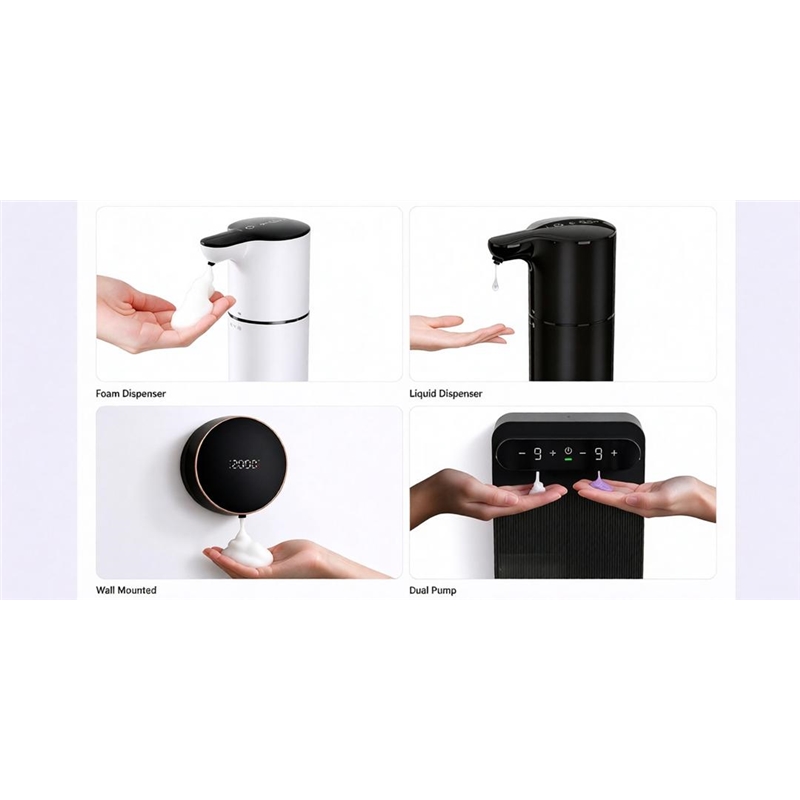
Understanding different dispenser types is essential for selecting the right product for a target market.
2.1 Automatic Foam Soap Dispensers
Foam soap dispensers mix liquid soap with air to produce foam during dispensing.
Key advantages include:
- Convenient and lightweight foam application.
- Adjustable foam output on selected models.
- Suitable for households, hotels, restaurants, and offices.
- Potentially more controlled soap consumption, depending on the formulation and dispensing volume.
Some models require diluted liquid soap, while others are designed for ready-to-use foam solutions. Buyers should always check the manufacturer's recommended soap compatibility.
2.2 Automatic Liquid Soap Dispensers
Liquid soap dispensers deliver soap directly through an electronic pump.
They are commonly used with compatible hand soap, dishwashing liquid, body wash, and other cleaning liquids.
Important considerations include pump compatibility, liquid viscosity, dispensing volume, and anti-leakage design.
2.3 Wall-Mounted vs. Countertop Soap Dispensers
Wall-mounted models are designed to save countertop space and provide convenient access in bathrooms, kitchens, hotels, and commercial washrooms.
Common features include:
- Space-saving installation.
- Rechargeable battery systems.
- Touchless infrared sensing.
- Adjustable dispensing levels.
- Waterproof housing on selected models.
They are particularly suitable for locations where countertop space is limited.
2.4 Desktop Automatic Soap Dispensers
Desktop dispensers are freestanding devices that can be placed beside sinks, kitchen counters, or bathroom vanities.
Their advantages include flexible placement, easy installation, and convenient refilling.
Compact designs and modern finishes also make them attractive for household retail markets.
2.5 Dual-Pump Automatic Soap Dispensers
Dual-pump dispensers use two separate pumping systems and reservoirs to dispense different compatible liquids independently.
Depending on the design, they can support applications involving hand soap, body wash, shampoo, or other cleaning products.
These products can be particularly useful in hotels, hospitality facilities, and multi-product bathroom environments.
3. Applications of Touchless Soap Dispensers
The applications of touchless soap dispensers extend beyond residential bathrooms.
Residential and Commercial Applications
Homeowners use automatic soap dispensers for convenient handwashing, dishwashing, and daily cleaning. Compact designs, rechargeable batteries, and easy refilling are important features for household products.
Hotels, Restaurants and Public Facilities
Hotels often require dispensers that combine attractive appearance, reliable operation, convenient maintenance, and compatibility with their preferred cleaning products.
Wall-mounted and dual-pump models can be suitable for different hotel bathroom configurations.
Touchless dispensing can make handwashing stations more convenient for employees and customers. Buyers should evaluate durability, cleaning requirements, refill capacity, and applicable hygiene regulations.
Commercial washrooms need dispensers that can withstand frequent use. Battery performance, reservoir capacity, waterproof protection, and maintenance efficiency are important selection criteria.
Automatic soap dispensers are also suitable for consumer electronics retailers, home improvement stores, online marketplaces, and private-label brands.
For online sellers, product appearance, packaging, clear operating instructions, and product differentiation can directly influence purchasing decisions.
4. Key Features to Consider When Choosing an Automatic Soap Dispenser
For international buyers, choosing a reliable product requires evaluating both technical specifications and supplier capabilities.
4.1 Sensor Accuracy and Dispensing Performance
The sensor is one of the most important components of a touchless soap dispenser.
A reliable sensing system should:
- Detect hands consistently within its designed range.
- Reduce accidental activation.
- Maintain stable performance under normal operating conditions.
- Provide an appropriate response for different installation environments.
Infrared sensors are commonly used in household and commercial models. Some specialized products may adopt other sensing technologies.
Buyers should request sample testing to evaluate sensor sensitivity and dispensing consistency.
Not every automatic dispenser supports every type of soap.
Before purchasing, confirm:
- Whether the product supports foam or liquid soap.
- Recommended soap viscosity.
- Whether dilution is required.
- Whether dispensing volume is adjustable.
- Whether the pump and nozzle are designed to reduce clogging.
Using incompatible soap may cause inconsistent dispensing, leakage, or blockage.
4.2 Soap Capacity, Battery Life and Charging Options
Reservoir capacity affects refill frequency and product suitability.
Smaller capacities may work well for household use, while larger capacities can be beneficial in hotels and commercial environments.
A good dispenser should also allow convenient refilling and routine cleaning.
Rechargeable automatic soap dispensers offer convenience and reduce the need for frequent battery replacement.
Important specifications include:
- Battery capacity.
- Charging interface, such as USB or Type-C.
- Charging time.
- Standby power consumption.
- Number of dispensing cycles under defined test conditions.
Buyers should distinguish between laboratory estimates and actual battery performance in everyday use.
4.3 Waterproof Design and Product Durability
Automatic soap dispensers are frequently installed near sinks and washbasins, making waterproof protection an important consideration.
Buyers should check the product's actual IP rating and the scope of the relevant test report.
For example, IPX5 and IPX6 indicate different water-jet protection levels under defined testing conditions. IPX7 refers to temporary immersion protection under specified test conditions.
An IP rating should not be interpreted as permission to immerse every part of a product in water. The actual protection depends on the product construction and testing scope.
Materials such as ABS plastic, polypropylene, and stainless steel may be used in different product designs.
When evaluating a supplier, consider:
- Housing durability.
- Assembly consistency.
- Pump reliability.
- Leakage prevention.
- Electronic component quality.
- Aging and functional testing.
- Quality control procedures.
A professional manufacturer should be able to explain its inspection process and provide relevant product test documentation.
5. How to Choose the Right Automatic Soap Dispenser
Certification requirements depend on the product's electrical design, power supply, wireless functions, battery configuration, destination market, and applicable regulations.
Buyers should not assume that one certificate automatically covers every product model or every country.
Examples of requirements to investigate include:
| Market | Important compliance considerations |
|---|---|
| European Union | CE requirements applicable to the product, relevant EMC and RoHS obligations |
| United States | Applicable FCC requirements for electronic devices; other requirements depending on product design |
| United Kingdom | Applicable UK product conformity requirements |
| South Korea | Applicable KC requirements |
| Japan | Applicable PSE requirements where the product or power adapter falls within regulated categories |
| Canada | Applicable ISED requirements and electrical safety requirements where relevant |
For products containing lithium batteries, buyers should also confirm applicable transportation documentation, including UN38.3 test documentation and the required battery information.
Important: Compliance should be assessed for the complete product configuration, including adapters, batteries, and accessories. Always verify the applicable rules with a qualified testing or certification organization before importing.
6. OEM and ODM Automatic Soap Dispenser Manufacturing
For importers and private-label brands, working directly with an OEM/ODM manufacturer can provide greater flexibility in product development and brand differentiation.
OEM generally refers to manufacturing products according to a buyer's specifications or branding requirements. ODM usually involves a manufacturer's existing product designs or development capabilities being adapted for the buyer.
Common customization services include:
Appearance customization
- Custom product colors.
- Housing material and surface finish options.
- Product appearance modifications.
- Logo printing or branding.
Functional customization
- Sensor settings.
- Dispensing volume adjustments.
- Foam or liquid dispensing configurations.
- Battery and charging options.
- Product structure improvements.
Packaging customization
- Private-label retail packaging.
- Customized color boxes.
- Product manuals in different languages.
- Barcode and label requirements.
Product development
A capable ODM partner may support market research, industrial design, electronic engineering, mold development, prototyping, functional testing, and mass production.
Before placing an order, buyers should confirm the MOQ for each customization option, sample lead time, tooling costs, production schedule, and intellectual property ownership.
7. How to Choose a Reliable Automatic Soap Dispenser Manufacturer
Finding a supplier is relatively easy. Finding a manufacturer that can consistently deliver products meeting your market requirements is more important.
Here are seven practical points to evaluate:
- Manufacturing experience: Review the supplier's experience in automatic soap dispensers and related electronic products.
- Product development capability: Check whether the factory has in-house engineering and product design resources.
- Quality control: Ask about incoming material inspection, in-process inspection, finished-product testing, and outgoing inspection.
- Certification documentation: Request reports and certificates applicable to the exact product model.
- Customization flexibility: Confirm available options for logo, colors, functions, and packaging.
- Production capacity: Evaluate whether the supplier can support both trial orders and larger repeat orders.
- Communication and after-sales service: Confirm response times, warranty terms, spare parts availability, and defect-handling procedures.
A good supplier should be willing to provide product samples, technical specifications, test documentation, and a clear quotation.
8. Why Choose Mingyuexun for Automatic Soap Dispenser Solutions?
Shenzhen Mingyuexun Technology Co., Ltd. is a manufacturer of smart home electronic products, including automatic soap dispensers, aroma diffusers, toothbrush sterilizers, and other household electronic devices.
With a focus on product development, manufacturing, and international B2B cooperation, Mingyuexun supports buyers looking for practical product solutions and private-label opportunities.
Our automatic soap dispenser product range includes:
- Wall-mounted automatic soap dispensers.
- Desktop touchless soap dispensers.
- Automatic foam soap dispensers.
- Automatic liquid soap dispensers.
- Dual-pump dispensing solutions.
Depending on the model, available features may include infrared sensing, adjustable dispensing levels, rechargeable batteries, waterproof housing, and anti-leakage designs.
OEM/ODM services
Mingyuexun supports product customization according to project requirements, including logo, color, packaging, and selected product functions.
For customers with specific product concepts, the development process can include design discussion, sample evaluation, functional testing, and production preparation.
Quality and manufacturing
Mingyuexun emphasizes manufacturing consistency, product inspection, and quality management throughout the production process.
For each project, buyers are encouraged to confirm the applicable product specifications, inspection standards, certification documents, MOQ, and delivery schedule with our team.
Whether you are a distributor, importer, retailer, hotel supplier, or e-commerce seller, we welcome inquiries about automatic soap dispenser sourcing and OEM/ODM cooperation.
9. Frequently Asked Questions About Automatic Soap Dispensers
Q1: What is the difference between a foam soap dispenser and a liquid soap dispenser?
A foam soap dispenser generates foam by mixing compatible soap solution with air. A liquid soap dispenser delivers liquid soap directly through a pump. The two types may require different soap formulations and pumping systems.
Q2: Can an automatic soap dispenser use regular liquid soap?
Some models support regular liquid soap, while others are designed specifically for foam solutions. Certain foam dispensers require dilution according to the manufacturer's instructions. Always check the product specifications before use.
Q3: Are automatic soap dispensers waterproof?
Some models feature waterproof protection, but the level varies. Buyers should check the actual IP rating and the relevant test report rather than assuming every automatic soap dispenser is waterproof.
Q4: How long does the battery of an automatic soap dispenser last?
Battery life depends on battery capacity, standby power consumption, dispensing frequency, motor performance, and operating conditions. Request test data from the manufacturer for a more reliable estimate.
Q5: Can automatic soap dispensers be customized with a private label?
Yes. Many OEM/ODM manufacturers offer logo printing, custom colors, retail packaging, and selected functional modifications. MOQ and development costs depend on the product and customization scope.
Q6: What is the typical MOQ for OEM automatic soap dispensers?
There is no universal MOQ. It depends on the existing product model, logo requirements, packaging, color customization, and whether new tooling or electronic modifications are needed. Buyers should request a model-specific quotation.
Q7: What should importers check before placing a bulk order?
Importers should confirm product samples, technical specifications, soap compatibility, battery performance, waterproof testing, applicable certifications, packaging, manuals, inspection standards, and delivery terms.
Q8: How can I find an automatic soap dispenser manufacturer in China?
Start by identifying factories with relevant product experience, engineering capabilities, quality control systems, and export documentation. Compare samples, customization options, MOQ, production lead time, and communication quality before selecting a long-term supplier.
10. Contact Mingyuexun for OEM/ODM Solutions
Choosing the right automatic soap dispenser manufacturer is an important step in building a competitive product portfolio.
Whether you need a standard touchless soap dispenser, a customized foam dispenser, a dual-pump solution, or a complete private-label product, working with an experienced manufacturing partner can help simplify sourcing and product development.
Mingyuexun Technology – Your Partner for Smart Home Hygiene Solutions
Contact our team to discuss your product requirements, request samples, or explore OEM/ODM cooperation.
Website: https://www.mingyuexun.com/
Email: sales01@myx1688.com
Product Category: Automatic Soap Dispensers
Contact us today for product catalogs, technical specifications, and customized quotations.


